
Authors: Mukhes Sri Muna, Andri Prima Nugroho, Muhdan Syarovy, Ardan Wiratmoko, Suwardi Suwardi, Lilik Sutiarso | Year: 2022 | DOI: https://doi.org/10.2991/978-94-6463-086-2_68
Counting the number of oil palm (Elaeis guineensis) trees in a plantation, especially one that spans hundreds or thousands of hectares, is traditionally a tedious task that takes months to complete and is prone to human error. Imagine a survey team walking on foot between rows of trees, counting and recording each one, under the scorching Sumatran sun. Now, with advances in remote sensing technology and artificial intelligence, this task can be completed in a matter of hours from behind a computer screen.
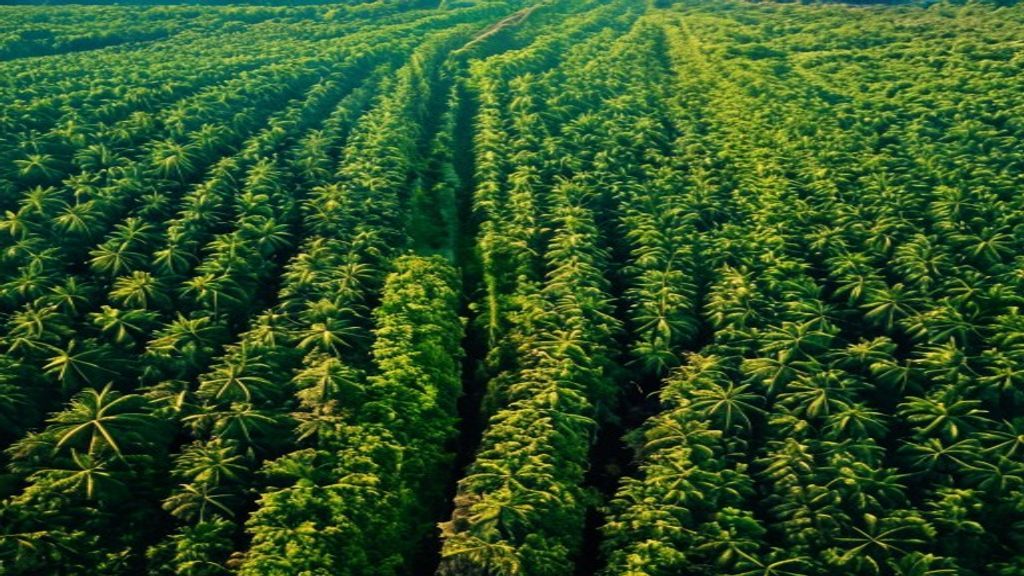
This research develops an automated system for counting oil palm trees using high-resolution satellite or drone images combined with deep learning algorithms, specifically convolutional neural network (CNN) architecture that has proven superior in pattern recognition in images. The model is trained using a dataset of images that have been manually annotated (each tree is manually marked by an expert), then tested in different areas to evaluate its generalization capabilities.

The results show that the developed system is capable of counting trees with a very high level of accuracy, exceeding 95% under good image conditions. The system can also distinguish between healthy and potentially diseased trees based on the canopy pattern visible from the air, opening up possibilities for early warning systems for diseases on a plantation scale. The main challenge identified is the decrease in accuracy under conditions with cloud cover or lower image resolution.
The following is a summary of the factors studied, their roles, and levels of influence.
| Factor | Role in Research | Condition / Context | Level of Influence | Specific Findings |
|---|---|---|---|---|
| Deep Learning Algorithm (CNN) | Key technology for automatic counting system, recognizing and counting oil palm trees from canopy patterns in aerial images | Model trained with manually annotated image dataset by experts, tested in different areas | Very High | Counting accuracy exceeds 95% under good image conditions, far surpassing the capability and speed of manual survey teams |
| Resolution & Image Quality | Primary determinant of system accuracy, model is highly sensitive to input data quality | High-resolution satellite or drone images, clear conditions without significant cloud cover | Very High | Main limitation: accuracy decreases in images obstructed by clouds or with lower resolution. Scheduling image acquisition during clear weather becomes critical |
| Tree Health Detection via Canopy | Additional capability: distinguishing healthy trees from those suspected to be diseased based on canopy patterns | Infected trees show different canopy patterns that can be recognized by the CNN model | Significant | Opens up potential for an early warning system for diseases on a plantation scale, suspected diseased trees can be prioritized for further field inspection |
| Automatic Periodic Inventory | Main operational benefit: accurate and updated tree inventory without significant cost and time | Can be performed routinely using increasingly affordable drones or satellite images | Significant | Accurate inventory data is foundational: harvest planning, production potential calculation, and data-driven plantation management systems |
| Model Generalization to New Areas | Ability of the trained model to be applied to different plantations without full retraining | Tested in areas different from the training data to evaluate generalization capability | Limited | Quality and diversity of manually annotated dataset determine how well the model can generalize to different plantation conditions |
With this system, accurate and up-to-date tree inventory can be carried out periodically without significant cost and time. This data becomes an important foundation for an accurate plantation management information system.
Do you have any questions about this research or similar experiences in your plantation? Write in the comment column, we are happy to discuss.
Glossary
- Neural Network (Artificial Neural Network)
- A computational model that mimics the human brain’s way of processing information. Used to recognize patterns in complex data and make predictions.
- Deep Learning
- A machine learning technique using multi-layered neural networks. Capable of recognizing very complex patterns from image, text, or time series data.
Sources
Muna, M. S., Nugroho, A. P., Syarovy, M., Wiratmoko, A., Suwardi, S., Sutiarso, & L. (2022). Development of Automatic Counting System for Palm Oil Tree Based on Remote Sensing Imagery. Scientific Journal. https://doi.org/10.2991/978-94-6463-086-2_68
Leave a Reply